


When reviewing someone else’s presentation, use these lists to help.
 Last night I coached a young woman who was being interviewed later this week for a $250,000 full ride scholarship to the college of her choice. She was tasked to give a 15 minute presentation and answer questions to an unknown panel. The challenge she faced is that the organizers from the admissions office gave her no guidance on what questions they wanted answered.
So she prepped a 12 minute demonstration of her robotic arm that won her all sorts of science olympiad awards and consequentially, admission into this prestigious engineering school (just the quarter-million-gulp-dollar-scholarship was on the line). The outcome of the review was that we worked hard to make her opening and closing about the college (not about her), to weave in her key message points about being creative and a problem solver, and found a few ways to interject an equally as impressive career in choir with a personal passion she had in rescuing cats. We walked away with a bit more humanism while not losing the intense technical jargon she believed they wanted to hear about her complicated robotic arm (all of which was way over my head, but I was not the intended audience, so I nodded and smiled during those minutes).
But as I listened to her talk, it brought me back to a training I did in content framing a few weeks ago for a large insurance company. My clients who sponsored the training are tasked daily with reviewing other people’s presentations and making giving them important feedback toward improvement.
But reviewing and giving feedback are hard to break down sometimes when you are busy. So I present here my definitive content review question guide – the critical questions you need to make sure are answered as you are reviewing any presentation.
As Atul Gwande taught us in the Checklist Manifesto, there are some checklists meant to be used before a task, and others, after. To that end, I have presented a “before” and “after” list for your use.
A jump start “before” list – top 5 questions to get a new presentation started:
Who is the audience you are presenting to?
What is the question on their mind?
What did they know about the topic beforehand? / What context do they need?
What is your bottom line answer?
What do you want them to do with the information after the presentation? (the goal!)
A review “after” list – what to look for after you’ve seen a presentation
Did I follow you? Did you tell me where you were headed in the first 2 minutes? Did you wander?
Do I know you / your story and why you have license to deliver the message (appropriate for new hires)?
Can I repeat your key challenge (problem) and answer to the challenge (solution)?
Did I know what you want me to do with the information?
Did each slide (if they were used) have a concluding idea, clearly stated in the header?
Did you give me anything to feel about the topic? Should I be scared? Excited? Moved to immediate action?
And lastly, do I see the intended audience inside the message? In other words, did you make the audience the central character of your story? (as opposed to the presenter being the central character).
####
As I think about the student pitching for the scholarship, the most important improvement we made was in having her ask for the scholarship, “Choose me for this scholarship and I will bring my passion and creativity to four years of academic excellence on your campus.” In the “before” version, she never stated her goal. In the “after” there was no doubt – she was not just there to share her robotic arm. She was there to be chosen and most simply, to win.
No Comments
Feedback without a License.
Wow, what a way to start the year.
I didn’t take my own advice.
Mid way through a recent assignment (an event featuring 5 different talks from the same company), I was told that I offended an executive by what I thought was a simple suggestion.
The suggestion was, “Have you ever recorded yourself?”
I love the recording devices on our phones. I’ve blogged about it here what a powerful Gestalt-like tool they can be for identifying your own problems in your speech, story or talk. You are more likely to correct the mistakes you identify versus those anyone tells you about.
And they are also great timing tools.
Sure you can use a clock, but that doesn’t help you identify where you may have gone long (or short) since you can’t hear yourself back.
His response to me was “I’ve done this a thousand times. I don’t need to record myself.” I just said, “I don’t need to hear it, but you can use it just to make sure your own timing is good.” After all, there were 5 speakers – if each of them went over 5 minutes, that’s nearly a half hour over their intended timeline. That kind of schedule oversight makes people like me batty, let alone the hundreds of folks in the audience.
So. In looking back, I ask myself: What went wrong? Was it really my suggestion? Was it the fact that he’s new to the job and doesn’t want to be questioned or appear vulnerable? Was it that I didn’t appreciate the fact he’d done it “thousands of times?” Was it that he doesn’t like feedback.
Maybe all or some of those applied, but a higher problem emerged.
He really didn’t know who I was. He didn’t know my story. He didn’t trust my advice or know that I have license to deliver it.
When we first met a few weeks earlier, I was limited to an introduction of this length:
“Hi, I’m Ruth Milligan, and I’m an executive speech coach.”
Anything more would have been frowned upon by the other 15 people in the room who had a big agenda to follow. And it was clear, at this moment of ‘said offense,’ that no one had ever shared with him what my true passion is, how I do it all day every day, how I lead with love and want everyone to reach their potential.
When we were in that script review meeting, it was to review a script (that is a story for another post). So to him, I was a writer. Or at least, if knew I was a coach, he had no ounce of willingness to be coached by me. I could have been introduced more thoroughly, surely, but the ultimate responsibility is mine.
As I have told my clients and classes for years, if people don’t know who you are, how can they trust you? And if you don’t tell them your story, how will they know the real you?
I was really looking forward to giving this executive some further feedback when the time was right. Sometimes, that time is just not meant to be. I wish him well. And thank him for this reminder that at the heart of my work, my clients have to want the feedback first, no matter how I am introduced.
Is it Really a Presentation Problem?

The look I imagine these supervisors had before calling me with the "presentation problem."
These are calls I’ve gotten recently from clients, concerned about performances of some of their key women.
“She is fine when she’s one-on-one with colleagues, but as soon as she goes into a group meeting or presentation, she clams up. We know she has good communication skills, but she refuses to use them.”
“During the presentation, she didn’t read the room well. She’s done this talk many times and practiced it over and over. Just because a few people were unhappy with the direction, it must have thrown her off because she just kept talking. Someone in the pitch ultimately asked her to sit down in the middle of her unfinished deck.”
“I had a board member look at me and say, “You say they do good work (this internal team made of women), but wow their presentations are horrible. How could that be? – they are a communications team!”
“She has a great communication style and reports that she isn’t nervous, but every time she starts a presentation or even a conversation with a group – she begins to be blush. Her neck turns completely red for at least 15 minutes. How could that be so incongruent with what she’s feeling inside?”
“She answered a question of a board member that should have taken 1 sentence to complete. Instead she took 5 minutes to get it out. She knew the information, what happened?”
Five different industries. Five different situations. Five different women, ages, backgrounds. So what’s the connection?
Each of these calls came from a concerned supervisor. They wanted me to help coach these specific executives into better communication behaviors. You know, be concise. Answer the question asked. Speak up. Be clear. Be compelling. Be engaging.
But each of these executives had communication skills. Sure, we could work on a few improvements. But there was other work that had to be done first.
I’ll call it grounding.
My colleague Suzanne Roberts is the expert at this, and I’ll extrapolate what I’ve learned from her insightful and sustainable somatic coaching.
We each have history and experience that comes with us wherever we are. And if that history and those experiences have not been reconciled – they will rear their ugliness at times of pressure, stress and uncertainty. Like a consequential presentation.
We don’t feel grounded. Or maybe more exactly – we may have consciously convinced ourselves we are grounded – but subconsciously, we really aren’t. And then our “psycho-biology” kicks in. In short, our body works without the advent of self-control from our brain. The closed body stance. The flush neck. Ignoring other’s non-verbals. Over-talking.
So when I was talking to the supervisor of the woman who wouldn’t speak up. I asked a few basic questions because I suspected what Suzanne calls “secondary trauma.” Meaning, she wasn’t personally injured or hurt, but she was around someone who was. Or saw pain and suffering that impacted her. Indeed, her parents were divorced and she had a sister that died in her teens. But more importantly, she had a previous boss who gave her difficult feedback – harsh, rude, negative feedback. Not ever positive or developmental. In those meetings she’s feeling like she has a faultine she’s standing on. So she freezes. It’s safe there (really?). There’s no risk in freezing since you do nothing (your body says). Until your supervisor says your job is on the line if you don’t step up and contribute (yipes!).
Others may flee – avoid the situation. Others defend – talking too much – questioning themselves and their knowledge. And even others may fight back. Take a punch, blame the behavior on someone else. “They didn’t prepare me well for the situation I was about to enter.”
The woman that ignored the feedback? She was trained as a beauty queen as a youth. She didn’t know how to take feedback that wasn’t smiling and clapping, so that’s what she looked for. She ignored all other signs of not doing “perfect.” She had no recovery mechanism.
So as you evaluate, coach and monitor both yourself and your colleagues’ communication inefficiencies, be sure to dig a little deeper at the subconscious triggers that are informing behavior. Because like it or not, we carry all of our experiences with us and it take work to know how to have self-control to keep them from getting in the way of a great presentation.
Articulation Inc will be addressing these issues in concert with Unifying Solutions with a new workshop offering in Fall, 2014. Email ruth (at) articulationinc.com for more information.
No CommentsThe journey to give a TEDx talk: A documentary.
After the first TEDxColumbus event in 2009 at the Wexner Center, I remember thinking the day after: why aren’t I doing more of “THIS?” This being helping speakers architect their story and find their voice. And deliver what I am now calling “The Talk of Your Life.” It is what lead me to create ar.tic.u.la.tion and the work I do every day.
Now, thanks to video producer Rich Bowers and his desire to follow the success of TEDxColumbus, the journey of two TEDxColumbus 2012 speakers and my passion for coaching people through this experience, we now have this awesome documentary. In a little over an hour, you’ll hear and see the pathway that Naomi Stanford and Jan Allen took on their way to the TEDxColumbus stage, and a lot of my ramblings on how I interpret the TEDx platform, preparation process and my coaching approach.
I’d like to personally thank Naomi and Jan for their participation and extra effort that went into this project. They allowed themselves to be vulnerable, transparent and authentic through each interview. It is my hope and goal that it becomes another valuable and insightful tool for future speakers to use to appreciate the successful ingredients to a wildly successful talk and experience.
Because as Jan said, “You come out of this process a different person than when you went in.”
And here are Jan and Naomi’s full TEDxColumbus talks:
No Comments
Tools of the trade
Rose Smith, during her highly provocative poetry performance at TEDxColumbus, challenged us all to betools. You know, as in a conduit for helping others, making change or doing good.
While my tip this month isn’t as deep, her challenge made me think about the tools that the speakers used during TEDxColumbus in their variety of preparation pathways (and let me tell you, there was some variety!). So, if you are making your list for Santa, here’s a few things to consider:
– A whiteboard. Map out your talk to see the main buckets of information or how it will flow. When you get away from your computer, the logic of your talk can have more meaning. Claudia Kirsch and I spent an afternoon shaping her sequence on a whiteboard which became a major point of clarity in refining her key messages.
– Your own personal clicker (yes, you can own one too). So that when your slides are done, you can practice working on transitions so that your verbal – vocal and visual messages align. We lent ours to Maryanna Klatt to practice with her slides, she said it made the world of difference. (Here are a few options of where to get one.)
– A recording device. The analog version would be a tape recorder, the digital might be voicememos on your iPhone or iPad. Theresa Flores used this extensively in her practice, whereby keeping the story in her head (and off of a script, the computer or notes) and making immediate improvements to her pace, sequence and influctions.
– Time. Give yourself the gift of some more days or hours to prepare. Bart Overly said he spent 100 hours preparing this talk (take a look at his slides and you’ll know why), Alex Bandar spent between 30-40, a more typical expenditure. Either one of them will tell you the time helped them be as prepared for their talks as any they’ve given.
While you may not be giving a TED/TEDx talk anytime soon, chances are one of these tools might come in handy for your next talk wherever it may be.
No CommentsIt’s my turn for the stage
This week I’ll be speaking at the Cityworks (X)po in Roanoke, Virginia. I was invited to speak on behalf of the TEDx global community, which now equates to 3417 events in 117 countries. Humbled, yes. Nervous, no. Since this is my “TEDx” season, the content is omnipresent in the brain, especially thanks to a great hour-long talk show with our leading local radio host.
For those of you curious about my preparation runway for a major talk, here are my 5 steps. These aren’t for everyone, but they work for me.
- Research on everything. Audience, venue, potential facts to include, reading trends, other related videos. Then let simmer.
- Work on governing idea – what’s the one thing I’ll leave them with? Develop no more than 3 key buckets of support. Brainstorm stories to resonate the buckets.
- Talk it through on my voice memos app. Transcribe it. Reverse engineer the outline to revise number two.
- Talk it through again, and make a list of visual imagery I need to resonate the stories. Research, download, buy or borrow visuals.
- Practice, syndicate and practice again. Make a note card with outline as backup.
One Client’s Pathway to Resonance
Everyone has their own preparation path toward great speaking, we’re thrilled to see what changes our clients have made in theirs.
One of our clients shared with me in an email that her speaking style had improved so much after her sessions with us. I asked her for what strategies were helping HER the most. Her response:
“In the past sometimes I would just wing it. I would know the topic and would just go for it. This new way I am ready to speak on every slide, I know it cold. They could do the slides backward and I could do it. I can also tell you exactly how long my program will be.
The other thing is the stories. I told stories in the past but did not place them in certain places on purpose – for example the story at the start to get their attention and why this program is something “they” need to hear…
I have also changed how I am introduced. I never liked for people to hear all that info about me. So I am much more comfortable with a short intro that tells them why they should listent to me.
The other thing I am doing different is I used to be a walker and now I stay behind the stand and it keeps me focused and helps me to look around the room in a more controlled uniform matter.”
No CommentsSeek the question
A friend told me recently he was invited to speak to the Board of Trustees at his institution. We discussed that while he knew the topic well, he didn’t know the exact question he was answering.
“Does there need to be a question,” he asked?
So — You decide which pathway would bring him to a more resonating presentation:
#1 : Address the topic: The college’s role in commercialization. His likely talk: Broad, linear, maybe rambling, definitely programmatic.
#2 : Question focus (hypothetically): Why is our college’s commercialization role slipping against other universities and what can we do to regain our leading role, and furthermore, more revenue for the institution? His likely talk: audience attentive, result oriented, anecdote rich, recommendation specific, highly resonating.
So this month’s tip: seek the question, even if your audience hasn’t expressly stated it. You must reveal the primal issue tugging at their minds to assure they will listen. And not to mention, it helps to achieve some critical presentation goals:
– it forces you to be relevant today. (i.e. can’t use the old talk from last month)
– it assures your talk isn’t a conversation with yourself
– it gives your story (i.e. the answer) hope of being syndicated (i.e. repeated)
And if you don’t know the question, don’t give the talk! Your audience will thank you for it.
No CommentsHow was your summer?
In our Influential Storytelling class at ar.tic.u.la.tion, we apply critical thinking methodologies to help properly frame a story. So on our summer family vacation a week ago, I thought I’d test the logic with my 7 year old daughter. What better story to practice than “what I did this summer,” knowing she’d be quizzed upon returning to school in a few days.
We found some post it notes at our cabin (lucky us) and brainstormed every memorable summer moment. After coming up with 40 points, I suggested we try to group them in 3 themes. We came up with four different grouping options:
One set were grouped by who participated in the moments with her and her brother – us, her sitter or others.
Another group was where they did them- at home, in town, or out of town.
A third was by old things, new things and things to repeat.
The last was by activity type – sitting down, standing up or in a pool!
Before you claim I’m a horrible parent for inflicting such a rigorous overlay to my daughter’s outstanding summer, she called uncle and stopped it as it was “boring.” And it was.
We hadn’t gotten to how to weave in the great visual support for any example – such as of learning to play tee ball, learning about Cleopatra in Cincinnati, building a train with her brother in the basement art space, or watching movies outdoors at the local park. For a seven year old, the fun was in the examples, not the story structure. Fair enough for a girl still on vacation.
The point is that she won’t have time or space to report all 40 activities when she answers the question. Ideally, she’d have a great narrative rooted in three general groups that revealed a supporting example- and illustrated succinctly why her summer was so awesome. Of course I don’t expect her (yet) to understand this, but by the time our official Storytelling Class closes each time, our clients certainly should.
So, tell me, how was your summer?
No CommentsThe heavy lifting is yours
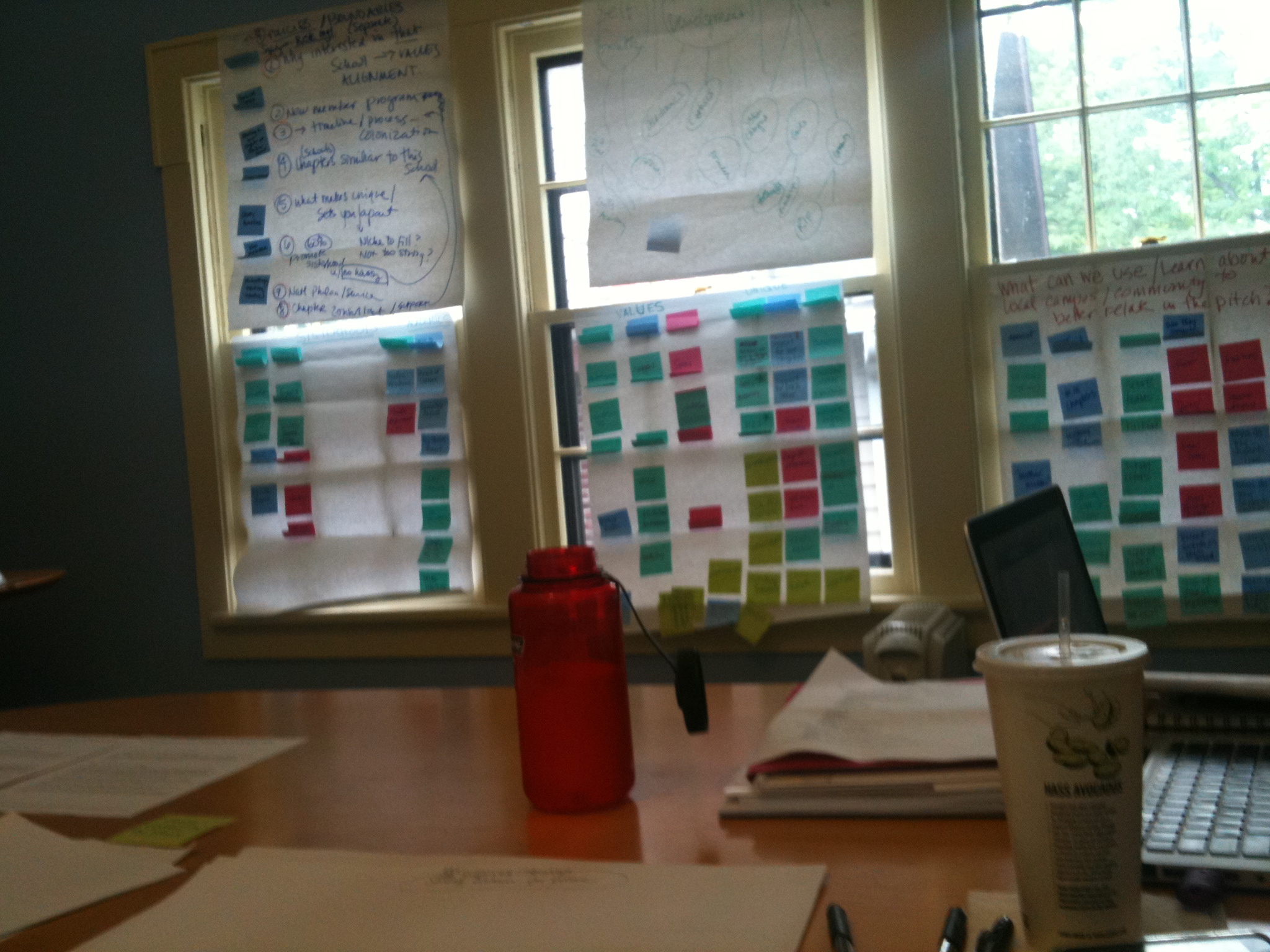 A client engaged us recently to architect a brand-new signature presentation. So we got out our very sophisticated tools: some markers, flip charts and a whole bucket of post it notes.
But we find the questions we ask at every step aren’t so simple: What insight can you reveal? So what? Why will your audience care? How will these points support your mission statement? Can you find a visual example to prove that point? And are you strong enough to know that lots of these ideas will end up in the trash?
It’s a messy process. But as we always like to say, make sure you don’t leave any of the heavy lifting for your audience.
No Comments